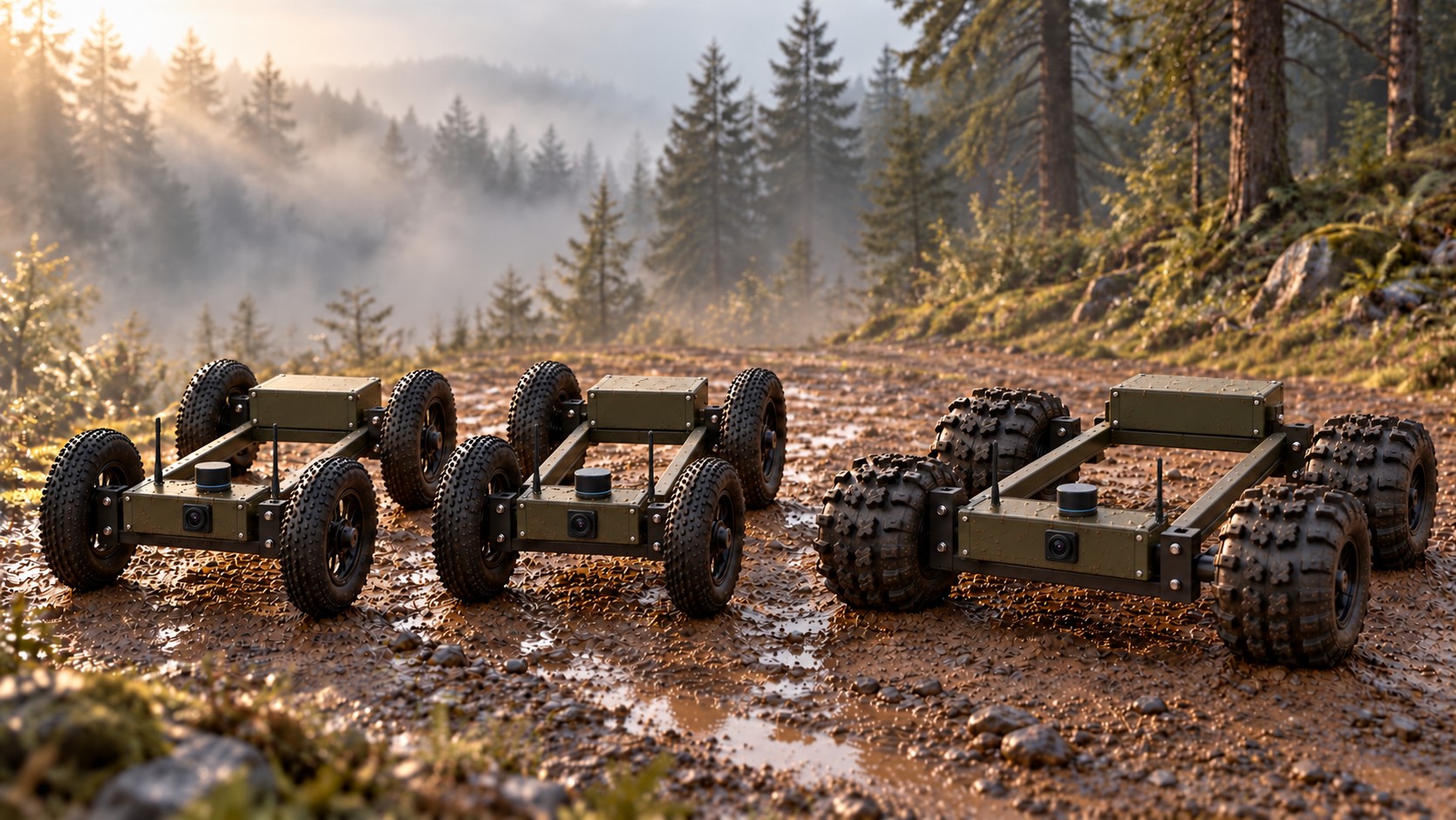
Concept equipment shown: compact camera, lidar and two antennas. Final equipment depends on the vehicle configuration.
01 / 4WD
Creeper Mule
Heavy autonomous support
The platform for substantial loads: up to 1,000 kg of combined module and cargo mass. Four-wheel drive and a larger, robust frame make Creeper Mule the heavy member of the family. Autonomous operation is in development.
Consolidate larger loads on one modular platform.
Bulk resupply
Carry multiple crates of food, water, clothing and other supplies in one load.
Support larger battery packs, portable power equipment or a communications module.
Medical transport support
Provide a base for a purpose-built stretcher module with room for medical equipment.
02 / 4WD
Fast Mule
Compact autonomous resupply
A light, mobile platform of 140 × 110 cm, with four-wheel drive and a payload up to 150 kg. Fast Mule is being developed for autonomous transport when a compact vehicle and smaller, targeted loads fit the task.
Deliver what is needed, in a compact load.
Targeted resupply
Deliver food, water, clothing and personal equipment to a small team.
Medical deliveries
Transport first-aid kits, medicines and dressings without using a heavy cargo platform.
Battery & parts shuttle
Bring replacement batteries, small spare parts and repair kits to where they are needed.
Compact communications
Carry a lightweight radio relay or communications module within the available payload.
03 / 4WD
Follow Mule
Support that moves with you
The 140 × 110 cm companion platform: four-wheel drive, up to 150 kg and two operating modes. Let Follow Mule follow the operator, or use the remote control to position and move it directly.
Keep equipment with the team and off their backs.
A team’s extra carrying capacity
Carry packs, drinking water and shared equipment while moving with a dismounted team.
Mobile medic’s equipment
Keep medical bags, dressings and rescue equipment close to the person providing care.
A moving tool carrier
Support maintenance or engineering teams with tools, parts, batteries and cable reels.
Directly controlled transport
Use remote control to move supplies between nearby positions or send the vehicle ahead while the operator assesses the route.
Application concepts are subject to module development and testing. Module mass counts towards payload; terrain, load and configuration determine practical performance.
One platform. Many roles.
CHANGE THE MODULE.
All three share the same layout: electronics at the front, batteries at the rear and space for interchangeable modules in the middle.
FRONT / VOORElectronics box
MIDDLE / MIDDENInterchangeable module
REAR / ACHTERBattery box
Daily resupply
Food, drinking water, clothing and personal equipment for the last kilometres.
Medical supplies
Transport first-aid kits, medicines, dressings and medical equipment.
Casualty transport
A dedicated stretcher module to support casualty transport within the vehicle’s payload limits.
Communications support
Carry a radio relay, transmitter or amplifier to a useful location.
Mobile energy
Bring spare batteries, portable charging equipment and power supplies where they are needed.
Tools & repair
Move tools, replacement parts and repair kits to equipment in the field.
Four-wheel drive on every model. No suspension. A low centre of gravity between the wheels. A straightforward, low-cost build with a disposable design philosophy.
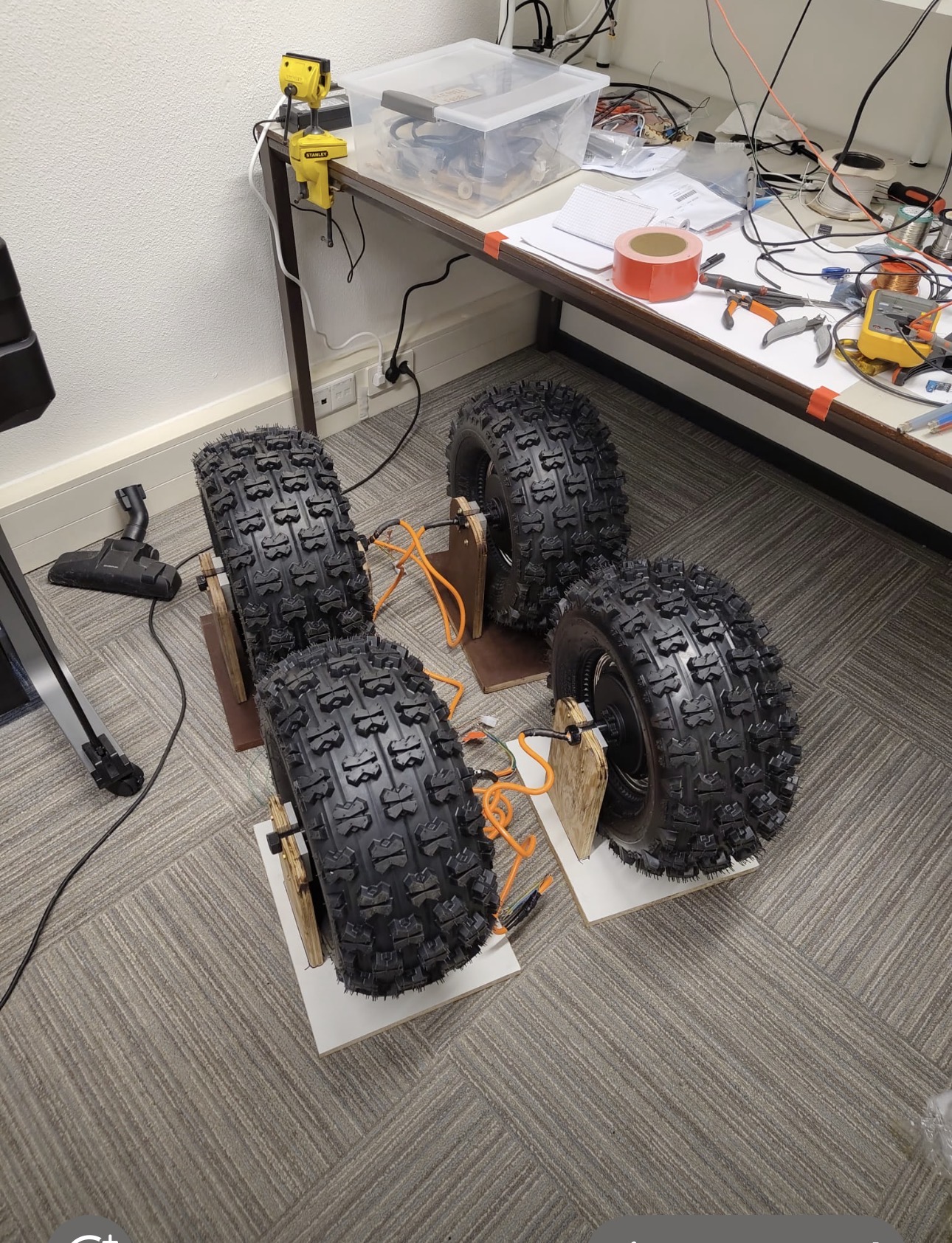
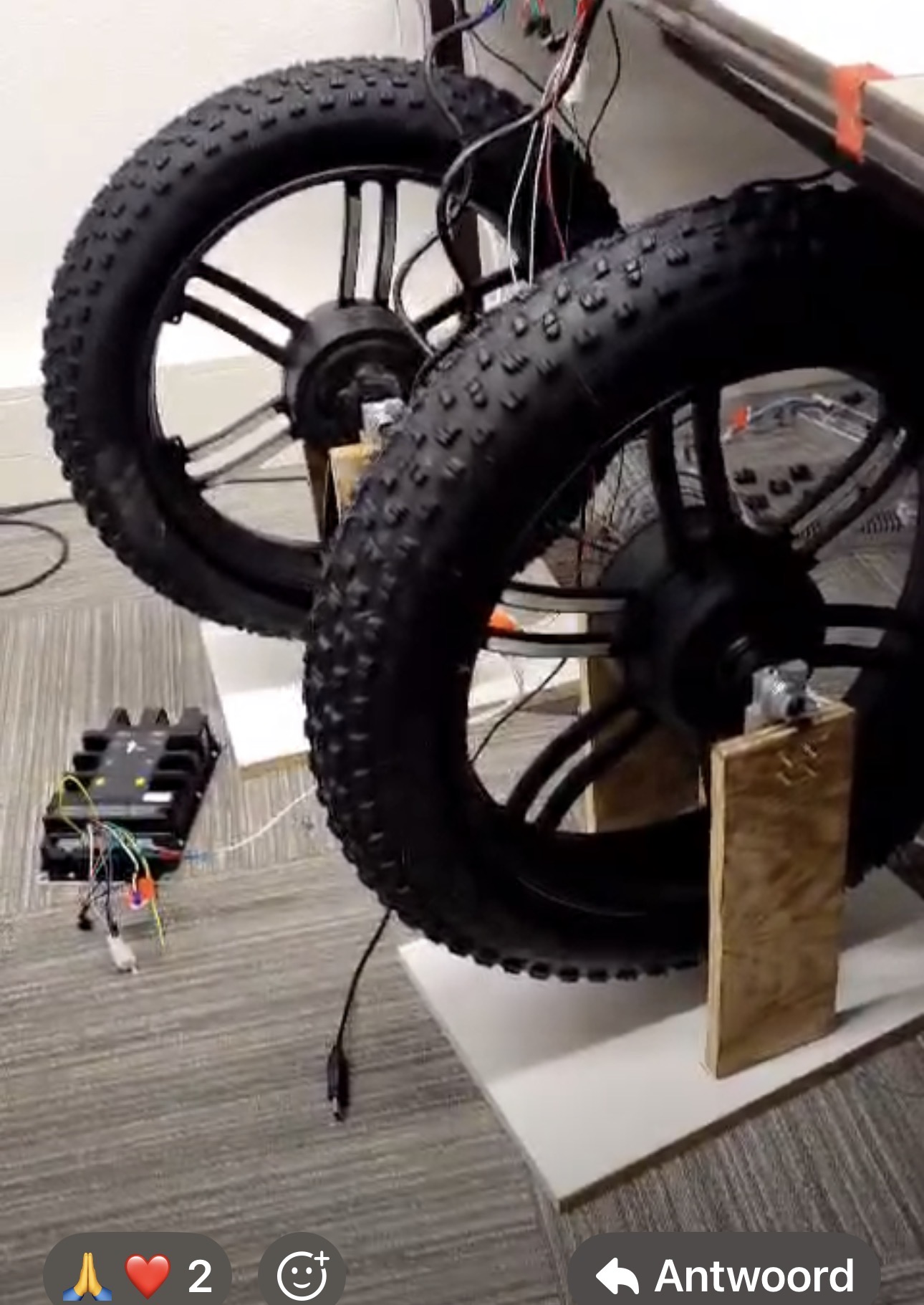
Wheel sizes are diameter × width. Creeper Mule uses wider but smaller-diameter wheels: 18 × 8 inches (45.7 × 20.3 cm), compared with the slimmer 20 × 4-inch (50.8 × 10.2 cm) wheels on Fast Mule and Follow Mule.
A family of complementary concepts, with a clear priority for each prototype.
Prototype
Creeper Mule
Fast Mule
Follow Mule
Drive
Four-wheel drive (4WD)
Four-wheel drive (4WD)
Four-wheel drive (4WD)
Control concept
Autonomous
Autonomous
Remote control + follow me
Frame scale
1.5× larger frame
Standard frame
Standard frame
Payload
Up to 1,000 kg
Up to 150 kg
Up to 150 kg
Length × width
To be confirmed
140 × 110 cm
140 × 110 cm
Wheels
18 × 8-inch broad terrain tires
20 × 4-inch fatbike wheels
20 × 4-inch fatbike wheels
Suspension
None
None
None
Layout
Modular
Modular
Modular
Primary focus
Strength
Mobility
Following support
Design direction
Heavy & robust
Light & fast
Operator-led movement
Intended role
Heavier cargo
Mobile logistics
Equipment transport
Current phase
Prototype development
Prototype development
Prototype development
Prototype specifications. Payload figures are design capacities; final performance depends on the configuration and testing.
From concept to the field
BUILT AROUND
A REAL NEED.
Carrying equipment takes energy. Military Solutions is developing unmanned logistics vehicles to help reduce that burden.
In development · Three prototypes
01
Develop with a clear purpose
Give each prototype a distinct role, from heavier loads to movement alongside the operator.
02
Put the prototypes to the test
Evaluate handling, usability and performance through practical trials.
03
Learn. Refine. Repeat.
Use test results and operator feedback to guide the next stage of development.
A personal reason to build
IT STARTED WITH
WANTING TO HELP.
With a Ukrainian wife and family living in Kyiv, Hans Luijkx began looking for a practical way to help. The challenge of the final kilometres of supply became the starting point for Military Solutions.